Showing posts with label election. Show all posts

Sunday, November 25, 2007

Kooyong results - Petro wins again and green vote holds well

I would like to thank the many people who helped out during the Kooyong campaign and on election day. Without you, the campaign would not have been so successful.

I would also like to thank the 7,457 people in Kooyong who voted Green.

Jenny Henty at Camberwell High school booth

I offer my congratulations to Petro Georgiou for his win again for the seat of Kooyong. I think Petro's strong stand on upholding the rule of law, human rights and fair treatment of asylum seekers and on the environment have stood him in good stead. In doing so I think Petro has demonstrated the only possible successful direction for the Liberal party.

Petro ran an honest and fair campaign in Kooyong, unlike many other electorates where the Liberals used negative fear tactics and distorted the truth. Petro was rewarded with virtually no swing against him, compared to an average national swing against the Coalition of -4.5%.

Petro Georgiou at Gennozanno College booth

I would also like to congratulate Kevin Rudd and the Labor party for winning the election and running a good campaign. I look forward to some real action on climate change in the very near future, starting with the next round of United Nations international negotiations in Bali in December.

Here are the results as of midday Sunday 25 November.

Kooyong:
  • HARVEY, Ken (Labor) 19,248 votes 30.94% +1.93 swing
  • GEORGIOU, Petro (Liberal) 33,987 votes 54.63% -0.03 swing
  • CAMPBELL, Peter (Greens) 7,188 votes 11.55% -0.99 swing
On these figures, the Greens primary vote dipped by about 1% while Labor's rose by about 2%. It seems that many people may have voted 1 Labor this time because they wanted a change of government, without understanding that they could also achieve this by voting 1 Green 2 Labor. Please note that this is not the final count so these figures may change a little.


Labor candidate Ken Harvey at Camberwell High School booth


National results in the House of Representatives:
  • Labor(two party preferred): +6.15% swing (a record win)
  • Liberals primary votes: 35.96% -4.51 swing
  • Greens primary votes: 7.64% +0.45 swing
  • Nationals primary votes: 5.38% -0.51 swing
The two party preferred voting system in the lower house really does favour the old parties. Even though nearly 8 out of a hundred people voted 1 Green across Australia no Greens were elected to the lower house.

Nationally, over 15 Labor seats were won on Greens preferences, including Deakin and Corangamite in Victoria, so there is a clear mandate for real action on climate change and more funding for public transport, public health and public education.

Senate results in Victoria


We are still hopeful that Richard Di Natale will be elected as the first Greens Senator for Victoria. However, even though Richard received a record 10.1% of the primary vote in Victoria, this is still short of a quota (14.3%). However analysis of preference flows indicates it will be difficult for Richard to be elected, although he is still in with a chance, even though 1 out of 10 people in Victoria voted for him in the senate. It most likely take 2 weeks before the final result is known.

Overall senate results and the balance of power

The Greens achieved two more records in the Senate:
  • Senator Bob Brown received 17.7% of the senate vote in Tasmania, a swing of 4.45% and has therefore exceeded a quota on primary votes and is re-elected. Congratulations Bob!
  • Kerrie Tucker received 22% of the senate vote in the ACT, a swing of 5.5%. However, a quota of 33.3% is required in the territories (which only have two senators). Kerrie is still in with a chance of securing a senate seat.
Other Greens results in the senate are:
  • Scott Ludlum is likely to be elected to the senate in WA
  • Sarah Hanson-Young is likely to be elected to the senate in South Australia.
  • Unfortunately, Senator Kerry Nettle has lost her bid to get relected to the senate in NSW.
On these results, the final outcome would be a total of 37 Coalition senators and 32 Labor senators, with the balance consisting of five Greens, one Family First and one Nick Xenophon (indepedent). If this eventuates, the Greens will thus not hold the balance of power in their own right. The Coalition will be able to stitch together a blocking majority with either Fielding or Xenophon or an absolute majority with them both.

Let us hope that both Richard Di Natale and Kerrie Tucker are elected to ensure the Greens have the balance of power in the senate.

What about climate change?


Prophetic Kev 4PM signing writing in the Hawthorn sky

Alistair McCaskill (Greens candidate for the neighbouring electorate of Chisholm) has provided the following excellent summation of the challenges for getting climate change and other green issues onto the political agenda.

This was clearly Labor's election, and the result is largely a reflection of the electorate's focus on the major parties combined with a mood for change. It's easy to think of additional things we could have done (locally), but it's clear they would have had little, if any effect on the final result. In the seat of Melbourne, with a budget many times larger than ours, a much larger support base, and Adam Bandt as a very capable candidate, the swing to the Greens was only 3.6%. This is a good indication of just how hard it is to change minds.

Even with the efforts of groups such as The Big Switch, GetUp, The Climate Institute, Australian Conservation Foundation, Greenpeace, Friends of the Earth, and numerous local climate action groups, I don't think climate change was the influential issue that many people suggested (and I hoped) it would be.

Links

Friday, November 16, 2007

You can help to turn Kooyong marginal


Senator Bob Brown and Peter Campbell, Greens candidate for Kooyong

Your help in Kooyong handing out "how to vote cards" for me on the 24 November would be greatly appreciated.

While Kooyong is a fairly safe Liberal-held seat, we can change the political landscape by making it marginal. There is even a very slim chance that the Labor candidate Dr Ken Harvey might tip out the Liberal incumbent (Petro Georgiou).

Kooyong has the 10th highest Green vote in the country, with your help we can move further up the ranks and force reaction from both the old parties.

Everyone in Kooyong can benefit from an increase in the Greens vote - if the margin the seat is held by continues to decline the seat will become "marginal" so it will benefit from the largesse that is showered on such seats during election campaigns. Voting 1 Green really does count.

You will notice that Kooyong has received no such attention this campaign. The Howard goverment takes voters in the seat for granted.

If you would like to help with the campaign, please contact me via Facebook or via this web form (which sends an email)

Regards, Peter

Friday, November 9, 2007

Greens win mock election at Canterbury Girls Secondary College

Canterbury Girls Secondary College holds a "mock election" event during the campaign of every federal election. This is an excellent opportunity for the student to hear from political candidates from a variety of parties, ask them questions, then vote on ballots similar to those used for the House of Representatives (lower house) in the upcoming federal election.


The ballots (votes) are then counted from the "voting booth" and preferences distributed. This provides hands on experience for how our prefential voting system works.

This year, I spoke as the Greens candidate for Kooyong. My "opponents" were the Petro Georgiou (MP for Kooyong), Senator Lyn Allison (Leader of the Democrats) and Barbara Norman (Labor candidate for Higgins).


A wide range of topics were covered and as usual many good questions were asked.

I was fortunate enough the win the majority of primary votes, and be declared the "winner" after preferences were distributed. Here is the primary vote percentages:

Lyn Allison 16.4


Petro Georgiou 11.3


Peter Campbell 46.8


Barbara Norman 22.4


Informal 3.1


Total 100


While this does not set a precedent for the outcome for Kooyong in the upcoming federal election, it was nonetheless pleasing to see and hear so many year 9 students with a keen interest in taking real action on climate change and many other Greens policies I spoke about.

Greens how to vote card for Kooyong

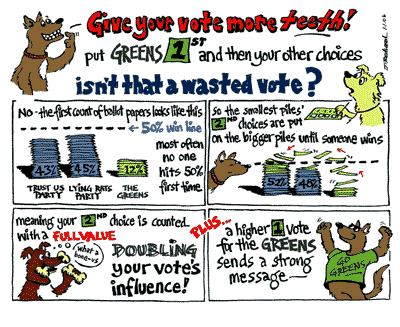
I have been getting some recent questions about Greens preferences. The first point I make is that we recommend to voters that they carefully choose where to place their second preference. Voting 1 Green sends a powerful message, and if I don't get elected then the vote flows at full value to the next preference chosen by the voter.

This is our "how to vote card" recommendation for Kooyong in this election, in the order of the ballot draw:

3. Harvey, Ken (Labor)
6. Laidler, John (Family First)
4. Georgiou, Petro (Liberal)
2. Collyer, David (Democrats)
5. Curtis, Pierre – (CEC)

1. Campbell, Peter - Greens

Remember, this is only our suggestion to you. We recommend that you choose carefully where your second and later preferences go after you vote 1 Green.

We have carefully examined the other party's policies. The Democrats have many policies that are very close to the Greens, such as emission targets for addressing climate change and mandating energy efficiency standards for example. Our how to vote card has the Democrats as number 2.

In Kooyong in the 2001 and 2004 elections we left it voters to choose whether their preference ended up with Labor or Liberal. We did this by issuing a "split ticket" how to vote card which had a "to Labor" option and a "to Liberal" option after voting 1 Green.

However, this election Labor has committed to 2050 emission reduction targets, to ratifying the Kyoto Protocol, and to a 20% renewable energy target by 2020. While they are still avoiding setting 2020 emission reduction targets, we think their policies on climate change are significantly better than the Coalition. Our how to vote card has Labor as number 3.

The Liberals are taking no real action on climate change this election and are supporting nuclear power and spending excessive amounts of taxpayers money on coal research and development, rather than investing in renewables. In addition, many in the Liberal Party such as Nick Minchin and Mark Vaile are still openly skeptical about whether humans are causing climate change. However, Petro Georgiou has taken a principled stand on the treatment of asylum seekers over the term of the Howard government. The Liberals are number 4.

Family First have very poor policies on climate change and are lobbying hard to reduce the retail price of fossil fuel which will increase its use therefore our carbon emissions. They also voted against the Greens Senate motion (along with both Labor and Liberal) to set a 2 degree temperature increase as the maximum tolerable rise and use this to guide energy policy and regulation. We have therefore put Family First at number 5.

The CEC come last at number 6. They are openly skeptical about whether climate change actually exists - which is an untenable position to take in this time of decreased rainfall, rising temperatures and bushfires. Science clearly demonstrates the humans are causing climate change by excessive greenhouse gas emissions.

Please contact me via mobile 0409 417 504 or email if you have any questions about this.

Street stalls around Kooyong

We have been out in the community visiting strip shopping centres such as Balwyn, Glenferrie Road and Camberwell. We hand out the Green Times newspaper which has some excellent articles on the problems with WorkChoices, setting climate targets, how to improve public education, forest conservation and West Papua.

Many people have told me they are greatly concerned about climate change, and that the old parties are not doing enough about it.

I
think it is becoming increasingly apparent that if you want real action on climate change, both in the House of Representatives and in the Senate, your best option is to vote 1 Green.

Jenny handing out the popular Green Times newspaper in Camberwell

Tuesday, October 30, 2007

Greens TV ad and the 3 parties video

Here is the new Greens TV ad. I think it is well worth a look.


Another excellent video produced by the campaign group GetUp is below. 3 Senators from 3 parties (Labor, Greens and Democrats) supporting each other in the interests of a balanced Senate:


And Who on Else Cares is an interesting site that allows you to register your concern about climate change, send a letter to your local federal MP and see who else cares about climate change is on the map too.

More kindergarten places are needed for Kooyong


The local Progress Leader newspaper (31/10 edition) covers of concerns about funding for the Manresa kindergarten and increased childcare costs in Boroondara.

I am hearing from many people in the Kooyong electorate that there is a real shortage of local kindergarten places. Many parents are forced to place their children at kindergartens some distance from where they live which is inconvenient and often requires car transport. I share this problem as I have a young daughter who may well miss out on a place at the local kinder.

Many couples are now starting families or have moved into the Kooyong electorate with children. The planning and provision of kindergarten services has just not kept up with this increased demand. In addition, successive interest rate rises have put more pressure on families with mortgages covering childcare costs.

Rather than dishing out $34b tax cuts during the election, I support federal subsidies for child care places and increased federal funding for more kindergarten places in Kooyong, and for the continued operation of the Manresa and other local kindergartens.

Links

Wednesday, October 24, 2007

Australia's climate change response, Guy Pearce

Guy Pearce spoke on 24 October at the Melbourne Town Hall on why the Australian government has failed to take real action to reduce our greenhouse pollution. Find out the interesting details from someone who's been on the inside. I took a video and have put it on YouTube in the following segments (videos are restricted to 10 minutes length).

Guy is on a speaking tour around Australia that has been organised and promoted by Greenpeace. His talk covers information that is included in his recent book High and Dry

Guy's talk gives some very good reasons why we need a change of government in Australia and Greens in the Senate to take real action on climate change.


Part 1: Guy's journey and forgotten Liberal Party history


Part 2: I love a burnt country?


Part 3: Behind Australia's world leading spin


Part 4: Carbon capture and the greenhouse mafia


Part 5: Denial, delusion and the election campaign


Part 6: What can we do?


Part 7: Being climate clever, not climate conned

Sunday, August 12, 2007

Young voters: get in early, make sure you enrol to vote

Many young people in Boroondara maybe unaware that recent changes to electoral laws mean that they could lose their right to vote.

The Australian government changed the electoral act in April so that when an election is called, those eligible to vote for the first time will only have less than a day to enroll before the rolls are closed.

Previously, the law allowed between two and three weeks for young people to claim this basic democratic right. It is hard to see what good effect the new provisions are intended to have. However, this law would seem to be a very effective way of reducing the participation of first time voters, of which there may be a thousand or more in Boroondara.

Parents, teachers, youth-workers and others in our community will have a useful role to play in getting this message to the young people of Boroondara.

The most important action now for those turning 18 this year is to enroll to vote right now before an election is called. This will ensure young voters are not locked out of the democratic process.

Post offices have the enrollment forms, or you can get them from the Australian Electoral Commission website. There is also now the requirement for proof of identity and a statutory declaration. The effort is worth it though so you can have your say in the future direction for Australia.

Links
  • Use this link to check your voter enrollment status online

Monday, June 11, 2007

Liberal and Labor, make a call: how much heat can you stand

Here is a good article by Richard Di Natale and Adam Bandt, who are both candidates for the Greens in Victoria in the upcoming 2007 Federal election.

I call on Petro Georgiou, the Liberal member for Kooyong, to set a short term target for carbon emission reductions of 20% by 2020.

The letter was published here in The Age on June 11, 2007. Text follows

What risk of a plane crashing do you accept before buying a ticket? If it was 85 per cent likely, you'd never fly; 10 per cent, or even 1 per cent, would be too much.

Knowing that a plane might go down isn't enough; we want to know the degree of risk. So it's odd that we are prepared to make decisions about the planet's future without knowing the risk or likelihood of catastrophic consequences if action is taken, or not taken.

It can be hard to cut through the fog of figures about global warming targets: the difference, for example, between a 60 or an 80 per cent cut in emissions, by 2020 or by 2050, is difficult to crystallise.

This confusion is being exploited by both major parties and manufactured debates are played out relentlessly. Labor presents itself as tough on climate change while the Coalition says it puts economics above abstract goals.

But more than anything else, there is one number that really counts. It is the first step on the ladder of climate-change policy — and it is the one to which neither Labor nor the Coalition is willing to give an answer.

Given the science and likely impacts, how hot are we willing to let the planet get? Two degrees, three degrees, four degrees hotter?

And what risk will we accept of exceeding this target?

Temperatures have, already, risen 0.74 degrees above pre-industrial levels and, even if human activity added no more to current greenhouse gas levels, the planet will continue to warm about 1.4 degrees due to lags in the climate system.

The CSIRO last year predicted that, if we exceed a two-degree rise, 97 per cent of the Great Barrier Reef will be bleached annually and an 80 per cent loss of Kakadu's freshwater wetlands is likely. At just under three degrees, there's a 99 per cent risk of Greenland irreversibly melting, with an eventual global sea level rise of five to seven metres.

In the two to three-degree range, we can conservatively pencil in about 20 per cent of the planet's species becoming extinct and a one in five chance of the oceanic currents that regulate the planet's temperature simply shutting down.

A three-degree rise is simply way outside human experience. The last time it was that hot, in the Pliocene, 3 million years ago, beech trees grew in the Transantarctic mountains and seas were 25 metres higher.

If we can limit warming to less than two degrees, knowing about 1.4 degrees is already locked in, the consequences will still be severe, but the risk of triggering runaway climate-change events (where we lose the capacity to control the consequences) lessens significantly.

This is why German Chancellor Angela Merkel and the British Conservative party — both from the right of European politics — have recently reaffirmed the importance of a two-degree limit. The Howard Government, by contrast, isn't even in the realm of reason on this question, with the Prime Minister saying a rise of four to six degrees might make life "uncomfortable" for some, but that it was difficult to predict with any certainty.

His comment shows fundamental ignorance. The planet as we know it will not survive past a five or six-degree rise: it is predicted that, at four degrees, hundreds of billions of tonnes of carbon locked up in Arctic permafrost — particularly in Siberia — will enter the melt zone, releasing the greenhouse gases methane and carbon dioxide in immense quantities.

Labor might know where the ballpark is, but they haven't bought an entry ticket yet. The ALP's Peter Garrett set out his party's policy on this page recently (The Age, 5/6), relying on a CSIRO submission to the Prime Minister's emissions taskforce that says a 60 to 90 per cent cut to industrialised countries' emissions is needed to stabilise climate change.

But Australia, as one of the worst emitters among the industrialised countries, requires a cut at the higher end of this range.

The CSIRO research and other research makes it clear that the "temperature stabilisation" associated with a 60 per cent cut is considered by many as too risky, giving us a massive 80 to 85 per cent chance of overshooting a two-degree target. Labor's policy for Australia of a 60 per cent cut by 2050 is therefore more about hope than science.

There is literally a world of difference between a two and three-degree rise in the impacts of climate change on both humans and the environment.

Caught between the science and the politics, Labor's Peter Garrett talks vaguely in the two to three-degree range, never being specific, never committing Labor to putting even one foot on the first rung of the climate change policy ladder — an unambiguous target.

And Labor does not have a short-term target — in many ways much more important than targets five decades away.

The Greens policy is to achieve emissions cuts of 30 per cent by 2020 and 80 per cent by 2050. This would give us an 80 per cent chance of keeping the temperature rise below two degrees. To maximise the chance of staying below two degrees, we must make big cuts early. For John Howard, a climate-change sceptic, this is more about smoothing over a political problem than real action. But Labor, too, falls short of the mark — they do not even set a temperature target.

Professor Tim Flannery, the Australian of the Year environmentalist, said recently his greatest wish was that political parties would state their "temperature limits" as to how hot the planet should get. The Greens recently moved a motion in the Senate to have a two-degree limit endorsed as Australia's target. The ALP joined with the Coalition to defeat the motion.

The challenge to the major parties is: just how hot are you prepared to let the planet get?

Monday, May 28, 2007

Peter Campbell, Greens candidate for Kooyong


Peter Campbell has lived in Melbourne’s eastern suburbs all his life. He attended Greythorn High School before undertaking his tertiary education at Latrobe University. Peter is married with 1 child and lives in Surrey Hills in an environmentally friendly renovated house that exports electricity to the grid from twenty solar panels and is self sufficient for water.


Peter works as an IT consultant, and enjoys bushwalking, climbing, kitesurfing, skiing and cycling. These outdoor activities have led him to be active on sustainability and conservation for over 20 years, including the protection of native forest and wilderness areas, the promotion of public transport and cycling, addressing climate change and promoting renewable energy. Peter believes that social justice issues such as education, health and employment conditions are intrinsically linked to environmental issues.

Peter’s local activities include:
  • Committee member and former chairperson of Friends of South Surrey Park.
  • Membership of the Boroondara Bicycle User Group and promotion of the proposed Eastern Rail Trail
  • Field Organiser with Bushwalkers Search and Rescue which assists Police with search and rescue activities throughout Victoria.
  • Local climate change campaigning and advocacy
  • Founder of Greenlivingpedia.org website for sharing information on sustainable living.

If elected to parliament, Peter will work to:
  • Take real action on climate change by setting goals for Kooyong to become carbon neutral and introducing a target of reducing Australia’s greenhouse emissions to 30% below 1990 levels by 2020 and to 80% below by 2050.
  • Secure Victoria’s water supply and protect endangered animals by stopping logging in water catchments and our ancient forests.
  • Create more childcare places in Kooyong.
  • Obtain Federal funding for more safe and convenient bicycle paths and routes for local and commuter use.
  • Uphold our freedom of speech, which is essential for democracy and human rights.
  • Secure Federal funding for improving public transport so that services are fast, reliable, frequent and well-connected.
Contact Peter Campbell via e-mail kooyong@greens.org.au or mobile 0409 417 504.

About Kooyong

Kooyong is an eastern inner metropolitan electorate covering an area of approximately 49 sq km stretching from Kew and Hawthorn in the west to Balwyn and Canterbury in the east, and from Balwyn North in the north to Hawthorn East and Camberwell in the south. Its suburbs include Balwyn, Balwyn North, Canterbury, Hawthorn, Hawthorn East, Kew, Kew East and parts of Camberwell, Glen Iris and Surrey Hills.

For a more detailed map of the district, visit the Australian Electoral Commission's website

Additional information

Greens historical results in Kooyong:
  • 2004: 12.54 % - the 11th highest Green vote in Australia
  • 2001: 10.72 % - the 10th highest Green vote in Australia
  • 1994: 28.03% by election, Peter Singer

On 28 May The Age reported poll results of a swing to Labor in Victoria running at 10%, which would meant that if an election was held now the Liberals would lose Kooyong which is held by Petro Georgiou on 9.6%.

Sir Robert Menzies held seat for the Liberals from 1934 to 1966.