I would like to thank the many people who helped out during the Kooyong campaign and on election day. Without you, the campaign would not have been so successful.
I would also like to thank the 7,457 people in Kooyong who voted Green.
 Jenny Henty at Camberwell High school booth
I offer my congratulations to
Petro Georgiou for his win again for the seat of Kooyong. I think Petro's strong stand on upholding the rule of law, human rights and fair treatment of asylum seekers and on the environment have stood him in good stead. In doing so I think Petro has demonstrated the only possible successful direction for the Liberal party.
Petro ran an honest and fair campaign in Kooyong, unlike many other electorates where the Liberals used negative fear tactics and distorted the truth. Petro was rewarded with virtually no swing against him, compared to an average national swing against the Coalition of -4.5%.
 Petro Georgiou at Gennozanno College booth
I would also like to congratulate
Kevin Rudd and the Labor party for winning the election and running a good campaign. I look forward to some real action on climate change in the very near future, starting with the next round of United Nations international negotiations in Bali in December.
Here are the results as of midday Sunday 25 November.
Kooyong:- HARVEY, Ken (Labor) 19,248 votes 30.94% +1.93 swing
- GEORGIOU, Petro (Liberal) 33,987 votes 54.63% -0.03 swing
- CAMPBELL, Peter (Greens) 7,188 votes 11.55% -0.99 swing
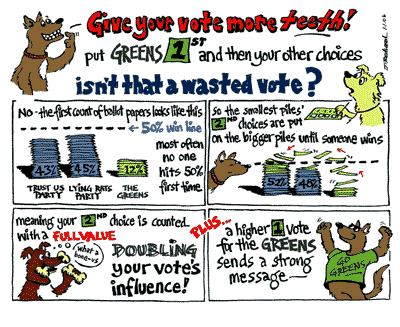
On these figures, the Greens primary vote dipped by about 1% while Labor's rose by about 2%. It seems that many people may have voted 1 Labor this time because they wanted a change of government, without understanding that they could also achieve this by voting 1 Green 2 Labor. Please note that this is not the final count so these figures may change a little.
 Labor candidate Ken Harvey at Camberwell High School booth
- Labor(two party preferred): +6.15% swing (a record win)
- Liberals primary votes: 35.96% -4.51 swing
- Greens primary votes: 7.64% +0.45 swing
- Nationals primary votes: 5.38% -0.51 swing
The two party preferred voting system in the lower house really does favour the old parties. Even though nearly 8 out of a hundred people voted 1 Green across Australia no Greens were elected to the lower house.
Nationally, over 15 Labor seats were won on Greens preferences, including Deakin and Corangamite in Victoria, so there is a clear mandate for real action on climate change and more funding for public transport, public health and public education.
Senate results in VictoriaWe are still hopeful that
Richard Di Natale will be elected as the first Greens Senator for Victoria. However, even though Richard received a record 10.1% of the primary vote in Victoria, this is still short of a quota (14.3%). However analysis of preference flows indicates it will be difficult for Richard to be elected, although he is still in with a chance, even though 1 out of 10 people in Victoria voted for him in the senate. It most likely take 2 weeks before the final result is known.
Overall senate results and the balance of powerThe Greens achieved two more records in the Senate:
- Senator Bob Brown received 17.7% of the senate vote in Tasmania, a swing of 4.45% and has therefore exceeded a quota on primary votes and is re-elected. Congratulations Bob!
- Kerrie Tucker received 22% of the senate vote in the ACT, a swing of 5.5%. However, a quota of 33.3% is required in the territories (which only have two senators). Kerrie is still in with a chance of securing a senate seat.
Other Greens results in the senate are:
- Scott Ludlum is likely to be elected to the senate in WA
- Sarah Hanson-Young is likely to be elected to the senate in South Australia.
- Unfortunately, Senator Kerry Nettle has lost her bid to get relected to the senate in NSW.
On these results, the final outcome would be a total of 37 Coalition senators and 32 Labor senators,
with the balance consisting of five Greens, one Family First and one Nick Xenophon (indepedent). If this eventuates, the Greens will thus not hold the balance of power in their own right. The Coalition will be able to stitch together a blocking majority with either Fielding or Xenophon or an absolute majority with them both.
Let us hope that both Richard Di Natale and Kerrie Tucker are elected to ensure the Greens have the balance of power in the senate.
What about climate change? Prophetic Kev 4PM signing writing in the Hawthorn sky
 (Greens candidate for the neighbouring electorate of Chisholm) has provided the following excellent summation of the challenges for getting climate change and other green issues onto the political agenda.
This was clearly Labor's election, and the result is largely a reflection of the electorate's focus on the major parties combined with a mood for change. It's easy to think of additional things we could have done (locally), but it's clear they would have had little, if any effect on the final result. In the seat of Melbourne, with a budget many times larger than ours, a much larger support base, and Adam Bandt as a very capable candidate, the swing to the Greens was only 3.6%. This is a good indication of just how hard it is to change minds. Even with the efforts of groups such as The Big Switch, GetUp, The Climate Institute, Australian Conservation Foundation, Greenpeace, Friends of the Earth, and numerous local climate action groups, I don't think climate change was the influential issue that many people suggested (and I hoped) it would be.
Links